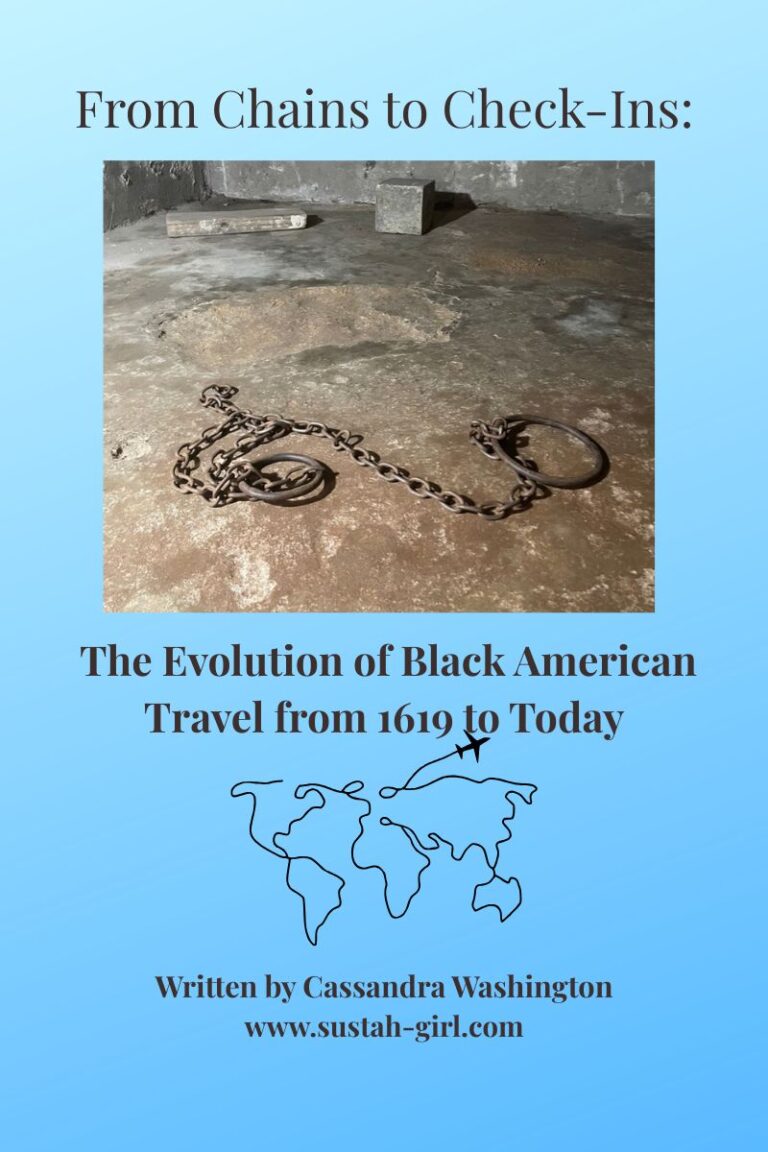
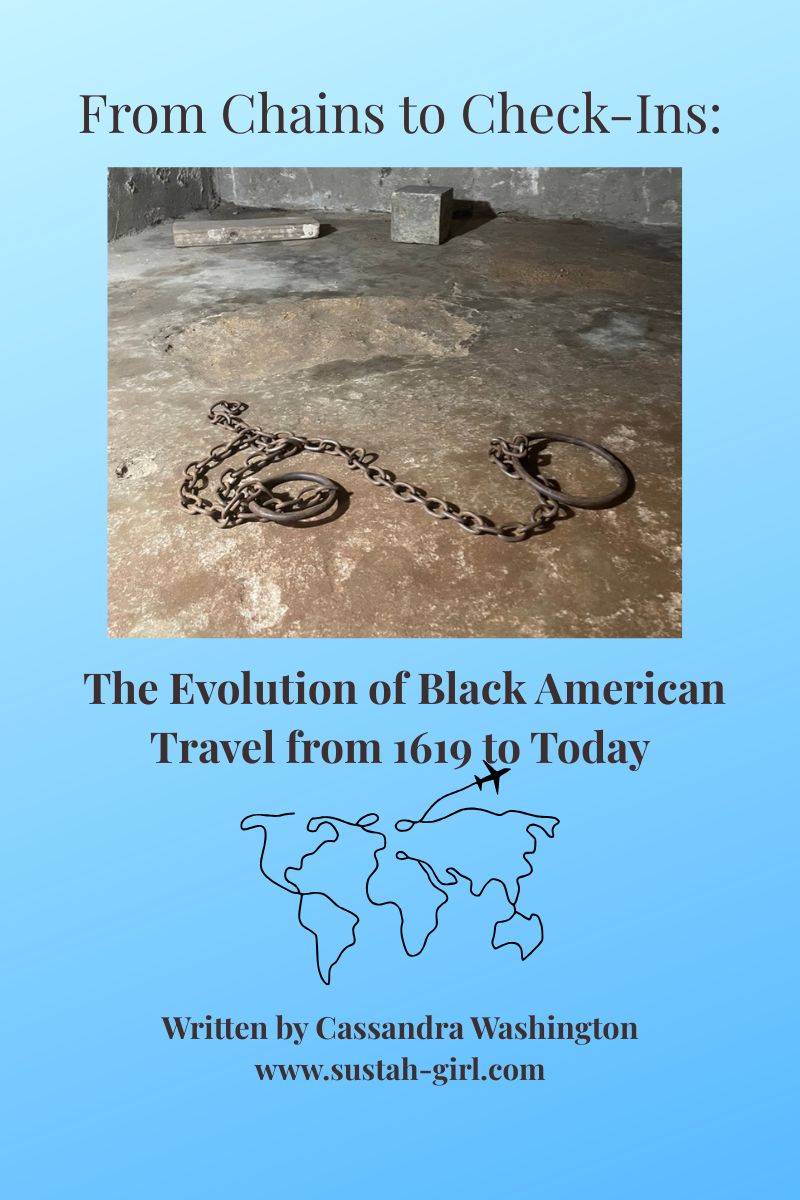
Travel Has Never Been Just About Vacations
As the United States celebrates 250 years of independence, it is worth asking a different question: What did freedom of movement and travel look like for Black Americans throughout those 250 years?
For many Americans, travel has long represented adventure, opportunity, leisure, and escape from the day-to-day responsibilities. For Black Americans, however, travel has often carried a very different meaning. It has been a story of forced migration, separation from family, escape from oppression, the search for opportunity, and ultimately the pursuit of freedom.
As a child of the 1960s and the child of parents who were born, raised, and inhabitants of the segregated South, I heard the stories and experienced how they had to navigate traveling across the United States. Furthermore, my grandparents and great-grandparents passed down the stories about the struggles and fears they had during the Jim Crow Era. It was not easy, and their travel plans required great strategic planning.
Imagine being legally relegated to the back of the bus. Picture in your mind substandard train cars for colored riders only. Visualize segregated airports while waiting on your flight to depart. Furthermore, imagine waiting on your flight, only for your seat or flight to be given away because of the color of your skin.
My, how things have changed. Today, Black travelers are among the most influential consumers in the travel industry. Black women over 50 are embracing solo travel, wellness retreats, cultural exploration, and international adventures. Yet this freedom to travel is rooted in a long and complex history stretching back more than 400 years.
Black Travel Timeline: 1619–Present
The first enslaved Africans arrived in Hampton, Virginia.
1808
The United States banned the international slave trade.
1820s–1860s
The Underground Railroad expands.
1849
Harriet Tubman escaped slavery.
1863
The Emancipation Proclamation was issued.
1865
Slavery was abolished in the United States.
1865–1877
During the Reconstruction Era, family reunification travel took place.
1896
The Supreme Court of the United States legalized segregation in Plessy v. Ferguson.
1915
The Great Migration from the South to the North began.
1936
The Negro Motorist Green Book was published.
1955–1968
The Civil Rights Movement transformed mobility rights.
1964
The Civil Rights Act was passed.
1970s–1990s
The Rise of Black Middle-Class Leisure Travel began.
2000s–Present
The growth of Black travel communities and global tourism expanded domestically and internationally.
Black American Travel Timeline
1619–1865: Travel Through Enslavement and Forced Migration
Travel Without Choice
The history of Black travel in America begins not with vacations but with forced displacement.
Millions of Africans were transported across the Atlantic Ocean through the transatlantic slave trade. The journey known as the Middle Passage remains one of the most traumatic migrations in human history.
Historians approximate that 1.8 to 2 million enslaved Africans died during the Middle Passage, translating to an average mortality rate of roughly 12% to 15%. These deaths were primarily the result of malnutrition, severe dehydration, and diseases like dysentery, scurvy, and smallpox in the cramped, unsanitary conditions below deck.
After arrival, enslaved people continued to experience forced movement through slave auctions and the domestic slave trade.
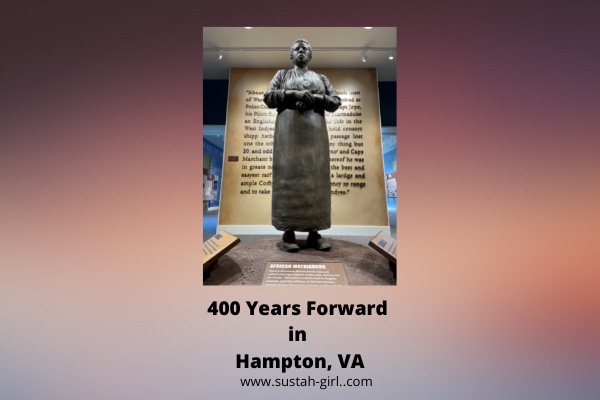
The Domestic Slave Trade
Movement and travel among slaves were the norm during the domestic slave trade. Families were separated and transported from states such as Virginia and Maryland to expanding plantation economies throughout the Deep South.
Before emancipation, enslaved Blacks had to possess passes from plantation to plantation. Also, freed Blacks had to possess and show proof of their freed status.
Travel during this period represented various traumas, including:
- Loss
- Separation
- Violence
- Forced labor
- Displacement
For generations of Black Americans, movement was not freedom. It was captivity.
1800–1865: Mobility as Resistance
The Underground Railroad
Eventually, for the enslaved, travel would become a means of escape. Despite the huge risks, enslaved people used movement itself as a tool of liberation.
The Underground Railroad became a network of routes, safe houses, churches, and abolitionists helping enslaved people escape to freedom.
Harriet Tubman
Not only was travel a means of escape, but Harriet Tubman transformed travel into an act of resistance.
She repeatedly risked her life, and she guided dozens of enslaved people to freedom through carefully planned routes and secret networks. According to the National Park Service, Harriet made 13 trips to Maryland to rescue friends and family members.
Harriet Tubman bribed people, followed rivers that snaked northward, and used stars and other natural phenomena to guide her journey.
For many escaping slavery, travel became synonymous with hope.
1865–1915: Reconstruction, Family Reunification, and New Opportunities
Traveling to Find Loved Ones
For many years, family members of enslaved persons were sold and sent off to plantations near and far. After the Civil War and following emancipation, formerly enslaved people embarked on journeys throughout the South and North searching for family members separated during slavery.
Remember, they were free but had no means of transportation, such as wagons, mules, or horses. Consequently, many traveled hundreds of miles on foot. Also, please note that travel through the southern states was not safe for Black Americans during the Reconstruction Era.
Building New Communities
Emancipation represented hope for a new beginning. Black Americans also traveled to:
- Attend schools
- Establish churches
- Seek employment
- Participate in politics
- Build businesses
For the first time, travel began to represent possibilities and opportunities.
1915–1970: The Great Migration
Moving Toward Opportunity
Possibilities could be attainable. Beginning around 1915, millions of Black Americans left the South seeking economic opportunities and greater freedom in cities such as Chicago, Detroit, New York, and Los Angeles. They arrived by bus, train, and automobile.
The Great Migration transformed American culture and reshaped Black life.
Travel as Transformation
Unlike earlier forced migrations, the Great Migration represented a voluntary movement toward opportunity and self-determination. One interesting fact is that Black newspapers, such as the Chicago Defender and the Pullman Porter, served as a source of information during the Great Migration. Southern Black people learned about opportunities in the North through the Chicago Defender. It was the most influential Black newspaper at the time and was carried into the South by Pullman Porters. The paper was banned in many southern cities and had to be smuggled in.
The outcome was that entire communities were built through these journeys.
Traveling While Black During Jim Crow
Freedom with Limits
Even after slavery ended, travel remained dangerous, especially in the South, in sundown towns, and on back roads. Separate but Equal was the law, and Black American travelers had to be strategic and careful.
Segregation laws restricted access to:
- Hotels
- Restaurants
- Public transportation
- Parks
- Restrooms
- Tourist attractions
Many Black travelers packed meals, slept in their cars, and carefully planned routes. I can remember traveling from Chicago to Arkansas with my parents. The trunk was packed with luggage, prepared meals, and a list of safe places to stop for a break. We would depart by car at 2 or 3:00 am, so that most of our driving would be done before sundown.
Sundown Towns
Thousands of communities across America effectively warned Black travelers not to remain after dark. Some sundown towns still exist in the United States.
Travel required vigilance, preparation, and courage.
The Green Book: A Survival Guide for Black Travelers
A Road to Safety
According to the National Park Service, “The Green Book, also known as The Negro Motorist Green Book, and later, The Negro Travelers’ Green Book, was a travel guide for African Americans, published from 1936 to 1966. The annual guide was designed to show businesses that did not discriminate against Black travelers. The book was named after its founder, Victor Hugo Green.
The Negro Motorist Green Book became an essential resource for Black travelers.
The guide listed those that welcomed Black customers:
- Hotels
- Restaurants
- Gas stations
- Tourist homes
- Businesses
More Than a Guidebook
The Green Book represented something larger than convenience.
It represented safety, dignity, and community.
It also highlighted the strength of Black entrepreneurship and Black-owned businesses.
Civil Rights and the Expansion of Mobility
Travel as a Civil Rights Issue
Years ago, I read an article Transportation and Civil Rights by Thomas W. Sanchez and Marc Brennan. An important point they make is, “Transportation is vital. The Supreme Court has recognized the right to travel as one of the fundamental rights guaranteed by the Fourteenth Amendment to the U.S. Constitution. The Universal Declaration of Human Rights, at Article 13, states, “Everyone has the right to freedom of movement and residence within the borders of each state.”
What does freedom mean to you?. The freedom of movement for Black Americans had been restricted for centuries. The lack of the ability to move and travel limited or confined Black Americans’ opportunity for the pursuit of liberty and happiness. Things were about to change.
The Civil Rights Movement challenged segregation in transportation, lodging, and public accommodations. The Freedom Riders exposed racial discrimination in interstate travel and helped accelerate change.
To learn more about the experiences Black travelers had during the Jim Crow Era, scroll down to the resource section. I’ve included links to several articles and websites for you.
The Civil Rights Act of 1964
The Civil Rights Movement and the Freedom Riders were resilient and purposeful in their fight. Finally, in 1964, President Lyndon B. Johnson signed the Civil Rights Act. This landmark legislation prohibited discrimination in public accommodations, transforming the travel experience for Black Americans.
The legal barriers to movement slowly began to fall. By law, Black Americans were legally able to move and travel freely; however, laws did not change the hearts and minds of many in the establishment. Despite the law, the fight for civil rights continues.
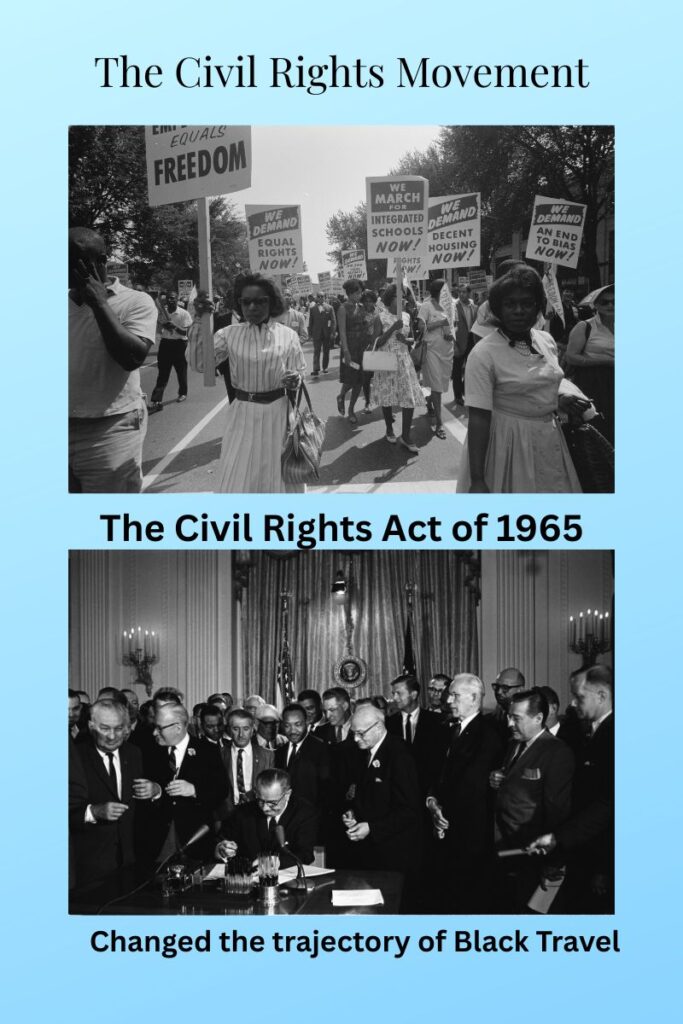
Black Travel Today: From Survival to Self-Care and Wellness
A New Era of Exploration
As barriers fell, new opportunities for movement opened. Today’s Black travelers are redefining travel. Accessibility opened the doors to hotels, resorts, tours, and destinations that had previously been closed.
Today, travel is increasingly connected to:
- Wellness
- Heritage
- Adventure
- Luxury
- Personal growth
- Cultural connection
The Rise of Black Women Travelers
Black women over 50 are among the most dynamic travel communities today.
Many are pursuing:
- Solo travel
- Wellness retreats
- International travel
- Heritage tourism
- Group travel experiences
For many, travel represents a form of self-care and self-discovery.
Visit the Sustah-Girl Chronicles Amazon Storefront
Book Your Next Flight on Expedia
Book Civil Rights Tours on Viator
Book Your Hotel on Booking.com
The Economic Power of Black Travelers
A Force in the Travel Industry
Black travelers contribute billions of dollars annually to the travel economy. According to a 2025 research study, Black travelers spend $145 billion annually on travel. The research was completed in partnership with MMGY, Black Travel Alliance, and the National Coalition of Black Meeting Professionals for an in-depth, multiyear examination of this growing travel segment.
“The data shown in these reports speak to the significance of Black travelers. It is also a wake-up call to many destinations that are considering adapting their current engagement strategy,” said BTA President Martinique Lewis, publisher of the ABC Travel Greenbook.
The following travel entities must recognize the economic power of Black travelers.
- Airlines
- Cruises
- Tours
- Cultural attractions
- Luxury experiences
- Destinations
Increasingly, destinations and travel brands are recognizing the importance of serving diverse travelers authentically.
Also, women over 50 are a formidable market, too. According to the article “How Women Over 50 Are Driving Billions in Travel Spending and Reshaping the Industry,” in the U.S. alone, 40 percent of women travelers are 55-plus, and their spending power amounts to $214 billion. Unfortunately, the spending is not broken down by ethnicity.

Conclusion: The Meaning of Freedom
From Forced Migration to Global Exploration: The History of Black Travel in America tells a larger story about freedom itself.
The journey began with forced migration and separation. It evolved through resistance, family reunification, migration, entrepreneurship, and civil rights activism.
Today, Black Americans travel the world in ways that previous generations could only imagine. I am an example of the transformation of Black America travel. My mother told me a story about traveling from Chicago to Arkansas on the Trailways bus. It was 1964, and I was two years old. She and I got off the bus in Arkadelphia, Arkansas, around midnight. The bus station was closed, and there was no way to contact relatives. No taxis were around, and the bus station was five or six miles away from the family home. My mother had to leave the luggage at the station, carry me in her arms, and begin the long walk home along a very dark two-lane highway.
Today, every passport stamp, road trip, cruise, wellness retreat, and international adventure reflects a remarkable transformation—from movement imposed by others to movement chosen for oneself.
The story of Black travel is ultimately a story of resilience, possibility, and freedom.
Resources
National Museum of African-American History & Culture
DuSable Museum of Black History & Education
Department of the Interior – African-American Historical Newspapers
The Smithsonian Museum – The Green Book
What It Was Like to Fly as a Black Person During the Jim Crow Era, Conde Nast Traveler, March 23, 2021
Traveling While Black, PBS, September 15, 2023
Segregation in Transportation, National Museum of Black History and Culture
Overground Railroad: The Green Book and the Roots of Black Travel in America by Candacy Taylor
Road Scholar Civil Rights Tours